Deep beneath Saqqara, in the tunnels of the Serapeum in Egypt, sit two dozen granite boxes that weigh tens of tons each, with flat faces and razor-sharp inside corners. In Egypt and Peru, enormous blocks are fitted together so tightly that you can’t slip a knife blade between them. How did ancient builders, without power tools or modern machinery (and certainly not lasers!), manage that? What if a great deal of that stone was never carved at all… but cast?
Where It All Started
That question has followed me for close to fifteen years now. It began with a library copy of Joseph Davidovits’ book “They Built the Pyramids,” which argued that much of the stone in the pyramids was cast in place as a kind of early concrete (what he calls a geopolymer) rather than quarried and chiseled into shape. The idea took hold and it became my novel “The Castors of Giza,” first published in 2012 and recently revised as the final book of The Days of Noah Series.
For years afterward, stone-casting stayed mostly on the page: a novel, a stack of research, and a personal curiosity. Then, about a year ago, while I was planning the rewrite of Castors, I came across the Natron Theory, developed by Hungarian researcher Marcell Fóti, who discovered (or rather, rediscovered) how to “melt” stone with molten natron (sodium carbonate), producing waterglass and the granite/mineral elements that comprise stone. Then by remixing the waterglass with granite, sand, or wood-ash, the stone can be reconstituted. After reading his book, I decided it was time to stop reading about it from the sidelines and get my hands dirty.
Enigma Stoneworks
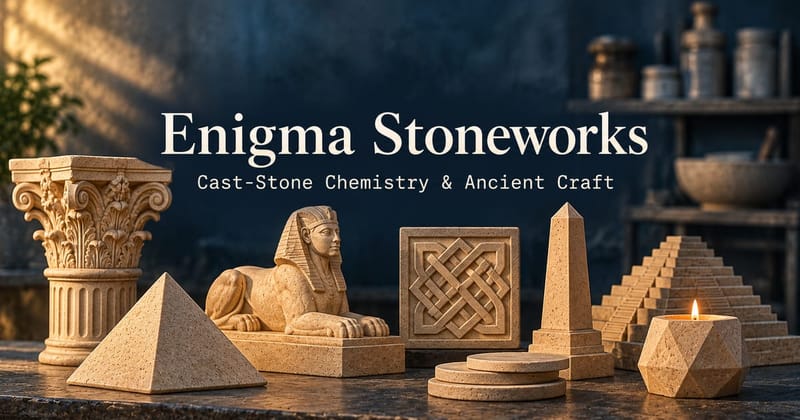
Enigma Stoneworks is my workshop: a home for cast-stone chemistry and geopolymer craft inspired by the ancient world. It’s where I cast, test, and share the results, from small cast-stone pieces and mold experiments to ancient-inspired artifacts (and yes, a few failures along the way). The site tells the story of how it all began, offers a short history of the stone mysteries and theories that inspired it, shows a gallery of recent work, and lists recommended reading on Davidovits’ pyramid theory, Fóti’s Natron Theory, and geopolymer formulations.
Stone Recipes
It didn’t take long in the stone-casting community to see that the bigger need wasn’t another workshop. It was a place where castors could learn, compare notes, and work out the chemistry together. That became Stone Recipes, a free, open community site where you can calculate, customize, and share stone-casting recipes and molds, post your own castings, and follow along with other people’s projects.
Whether you want to cast a small pyramid, a vase, or a cartouche, there’s a place to start. You’ll find recipes like Fóti’s Artificial Granite and Pure Limestone (for pyramid casing stones), a library of molds and resources, and a Getting Started guide for first-timers. Enigma Stoneworks remains the workshop behind it all, but Stone Recipes belongs to the whole community.
Why Talk About Stone?
One of the premises behind all of this, and behind The Days of Noah Series, is that the ancients (men like Noah, his sons, and their grandsons) knew how to make artificial stone. The ancients didn’t move 100-ton blocks hundreds of miles upriver, and they certainly didn’t waste years carving stone with copper tools. The Bible never describes the early world as primitive — that’s a modern assumption due to evolutionary biases. Adam (the first man) developed agriculture and shepherding with his sons. Cain (the son of Adam) built the first city soon after his first son was born. A few generations later, his descendants developed husbandry, musical instruments, and metallurgy of copper, bronze, and iron — complex, non-trivial feats. And after the Flood, that knowledge didn’t vanish with the Old World. It came through the Flood with eight people: Noah and his family.
Within just a few generations, Noah’s descendants on the plain of Shinar said to one another, “Go to, let us make brick, and bake them thoroughly. And they had brick for stone, and asphalt they had for mortar” (Genesis 11:3). While those two products (brick and asphalt) may seem common enough, producing them at scale is far from trival. In order to make brick, large kilns needed to be constructed to fire the bricks at the right temperature and the right consistency. The right type of clay, soil, and minerals needed to be gathered, refined, and combined in the proper proportions to make consistent bricks for firing. And for asphalt to be used for mortar, it first had to be refined from bitumen by several chemical processes, and before those chemicals could be used in refining, they had to be mass-produced. Building the city and tower of Babel was no easy task; it took complex planning, division of labor, specialization, and a sophisticated understanding of earth elements and chemistry.
After the tower of Babel was destroyed and the peoples were scattered over the earth, they took parts of that knowledge with them, though it was confused and fragmented. Some groups recovered faster than others, such as those of Sumer, Aratta (Ararat), Egypt, and the other early civilizations that sprang into history suddenly and fully developed. Some places didn’t have the resources needed for metalworking, brickmaking, or construction (or even agriculture), and that knowledge was soon lost. Many people were simply trying to survive, after all. (How well would we do if our specialized civilization was suddenly scattered and forced to start over?) However, in other places such as Egypt, the right elements and the right minerals were in the right place, and the people who still remembered enough of the knowledge and wisdom their ancestors settled that land. And then they began to build.
There’s a personal side to this as well, and it’s the reason this blog is called “Being Refactored.” Making and casting stone is a process of transformation: ordinary sand, ash, and mineral salts are dissolved, mixed, reshaped, and hardened into something new and lasting. Peter wrote that “You also, as living stones, are being built up into a spiritual house” (1 Peter 2:5). God is still in the business of taking ordinary, broken, useless materials and remaking them into something that endures, and every batch of artificial stone I pour is a small reminder of that.
Come Cast With Us
If you’ve ever looked at the pyramids, Sacsayhuamán, or the Serapeum and wondered how they were made, I’d love for you to join us. Read the story and see the work at enigmastoneworks.com, then head over to stonerecipes.com to try your first casting and share what you learn. And if you have questions, ideas, or results to share, you can reach me at enigmastoneworks@gmail.com.
It all began with a library book and a novel. I can’t wait to see where it goes from here!

