
Crossfit. Strength-training. Endurance exercises. Bigger, better, faster, stronger, longer, more. No pain, no gain.
 The gym I frequent (Tru-fit) is big into Crossfit, the current workout-regimen du jour that’s swept across America over the last several years. However, what they don’t tell you is that it can be very rough on your body after awhile, particularly when it comes to your joints and muscle-damage. Though we shouldn’t just “accept” aging and all that comes with it, we shouldn’t necessarily pour all our energy and focus into defying it either. Face it, at 40, 50, and 60, no matter how hard we work at it, we’re probably never going to be in the same shape (or look as good) as we were at 18, 20, or 22. Sadly, it’s a losing battle, especially if you work in an office! One of the unofficial Crossfit mottos is to “push through the pain”, but isn’t pain usually your body’s way of telling you to stop doing something? Besides, sooner or later, all those miles, push-ups, and pull-ups will catch up with us. The detriments of Crossfit may not show up for another 10-20 years in many of its adherents.
One of the inspirations for this post was the recent Christian marketing gimmick of “Cross-fit” in which the exercise apparel shows a picture of the Cross and a related Bible verse or two. Though it’s initially sort of cute/clever to latch onto Crossfit’s popularity and then try to redirect it to Christianity, after a while it seems like just another ploy a company is using to sell products in a semi-Christian market. And I can’t help but wonder how many non-Christian people think it’s just another desperate attempt to try to be relevant, if not politely marketing religion without speaking. I’m pretty sure that wearing clever T-shirts isn’t what Jesus had in mind when He said “Go into all the world and make disciples”!
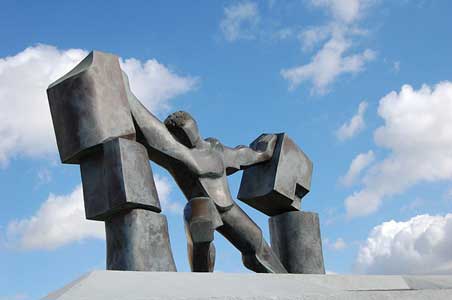
The other day while on the treadmill (right next to a surprisingly-fit guy I’ve nicknamed “The Plodder”), I was going thru Judges and reading about Samson. As I was doing my best to ignore the loud, endless thump-thump-thumping next to me, I noticed something interesting: the Bible gives no physical description of Samson except for his long hair. There’s no description of his stature, his looks, or even his height like Saul (one of the tallest men in ancient Israel). However, in every drawing or toy of him I’ve seen, Samson always has these huge muscles like Arnold Schwarzenegger — but that’s not in the text. Those are merely our assumptions. In fact, Samson was probably just an average-looking Jewish guy, which is why the Philistines were continually stumped as to where his source of strength actually came from (God!). If he had these huge muscles and lumbered around like Conan the Barbarian, wouldn’t it have been rather obvious? Why would his enemies have to bribe and threaten Samson’s love-interests to find out the source of his incredible strength?
The interesting thing about Samson (along with most other Biblical characters) is that he’s all too human — just like us. He had his dramatic, incredible victories and his pathetic, stupid falls over and over again. He recognized his weakness (women, particularly forbidden foreign/exotic women) yet did very little to resist his urges. He knew where the line was and not only kept crossing it, he kept leaping over it! Even when he knew he was being coaxed, tricked, and betrayed, he kept going right back to Delilah’s lap. He never learned from his mistakes until the very end when it was practically too late. All he could do at that point was throw himself at God’s feet and pray to be given one more chance, though he prayed only for vengeance.
 Honest, raw, in-your-face humanness in the Scriptures is one of the strong indicators that the Bible wasn’t written by mere men: every one of it’s heroes — save for One — has his/her own particular human faults. Aside from Jesus, I can only think of one or two (Daniel, Ruth, and maybe Ezra) to which no doubt or fault is attributed. Noah has his mishap with wine, Moses had his temper, David had his lust, Gideon had his gold, and Peter had his boastful oaths. In comparison, very few Greek/Roman/Egyptian myths highlighted faults and flaws in their heroes or gods, particularly in the sexual arena. Like modern stories and films, the excitement and emotions of the encounters/conquests are trumpeted but seldom the consequences. The only place where extramarital sex doesn’t have consequences or after-effects is in works of fiction.
For all his strength and courage, it seemed that Samson never seriously considered his weaknesses, particularly when it came to women. They were his blind-spot, and for his refusal to resist his urges and fear God, he was captured and literally blinded. When he fell because of his pride, everything he had placed his security in — namely, his great strength — quickly vanished. When he told Delilah the source of his strength (his hair), he didn’t really believe anything would happen if his hair was cut. Why? Because he’d been crossing the line over and over for awhile without any real consequence. In the end, he deceived himself both in that God wouldn’t keep His word and that Delilah really loved him. If only he would have feared God and built up defenses in his weak areas and steered clear of certain types of women, he might have gone on to many more victories against the Philistines and judged Israel much longer.
When it comes to our own personal strengths and weaknesses, what do we tend to rely on? Is it our intellect, our health, our bank-account, our job, our physique, our accomplishments, or our family (or even our church)? Where do we turn when it all hits the fan and the bottom falls out? Is that the same as where we should turn?
When it comes to our character, do we actively try to strengthen and build up what is weak or do we focus on mostly our strengths and minimize (or ignore) our weaknesses? Like Samson, do we deceive ourselves in that our strengths can more than compensate for our weaknesses? Like Samson, do we not fear God as we should and think that somehow we will be excused from the consequences of our pride and laxity? It’s been observed that the greatest falls occur during times of strength and ease, NOT during trials and tribulations.
 Are we “cross-fit” when it comes to God, that we try to follow Jesus’s command in Matthew 16:24 and Luke 9:23 in which we are to daily deny ourselves, take up our crosses, and follow Him?
When we daily deny ourselves and follow Him, we are less likely to become lax and prideful and then suddenly fall.
When we daily take up our crosses (however that looks), we are less prone to self-deception and being blinded by our own pride.
“Let not the wise man boast in his wisdom, let not the mighty man boast in his might, let not the rich man boast in his riches, but let him who boasts boast in this, that he understands and knows me, that I am the Lord who practices steadfast love, justice, and righteousness in the earth. For in these things I delight, declares the Lord.” — Jeremiah 9:23-24


 Would your life-story be glossed-over like many in the early chapters of Genesis and Matthew/Luke, where only a “X begat Y and lived Z years and died” verse was written? Would you even want your story to be mentioned? Would you want others to just be given the highlights, or would you want your life to be described in glorious — or humiliating — detail?
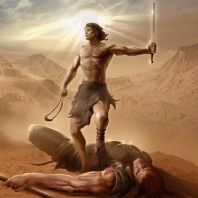 And then there’s David, the “man after God’s own heart” who had a weakness for women and sex, the proverbial “chink in his armor.” Next to killing the giant Goliath with a stone, David is known for committing adultery with the wife of one of his most loyal mighty-men and then having him murdered in battle. Though he was very decisive and won victory after victory on the battlefield, he proved to be passive and indecisive in his own household. Because of his sin (along with being polygamous), his daughter was raped by her half-brother who was then murdered by her brother, who then seized the kingdom from his father before being murdered by David’s chief of staff!
 When we step onto the Road of Righteousness with Noah, Abraham, Moses, and David and follow after Christ, we start walking with Him as Enoch and Daniel did. Jesus is committed to conforming us to Himself and remaking us from the inside out after the Holy Spirit comes to indwell our hearts. As we yield to Him and adopt His ways, we become more like Him. As we walk with Him, our story with all its faults fades and His story shines through us.

 However, for as much as He likes change, God Himself does not. In fact, He is probably the ONLY entity in this entire universe that never changes! In the Bible, God portrays Himself as a Rock to which we can go anywhere and anytime we want to. Our Rock is always solid and perfectly stable, and often He’s the only source of stability in this very unstable, unpredictable, and often chaotic universe (at least in our understanding)!

 While it may seem that injustice and the “prospering of the wicked” (or even the “not-so wicked”) is prevailing in this present world, Psalm 73 assures us that it’s only for a time. God is not mocked and everyone — each one of us without exception — will reap what we have sown. Those who sow to the flesh and spurn God and His ways will reap what they sow, while those who live faithfully and blamelessly before Him will reap His rewards (Galatians 6:7,8). And those rewards aren’t just for Eternity, but often here in the present time, as well as later on.
 There are thousands upon thousands of different kinds of weeds. There are those that grow thin and tall with shallow roots, those that spread and grow rapidly (practically overnight), those that are thorny and prickly and even poisonous. There are those that look small and pretty but whose roots go deep and are tough to dig out. And then there are the ones that seem delicate and beautiful because they have small bright flowers, so you leave them alone until you realize they’ve taken over most of the lawn — like dandelions and bindweed. When I see bindweed, I’m often tempted to rip up the entire yard and replace every inch of grass with cement and rocks like they do in Arizona!
 First, you need to soften the soil, either with water, air, or both (and sometimes earthworms). Back home as kids, we had a love/hate relationship with rain. We loved it because it cooled everything off and gave us a break from working outside. However, as soon as it was over, Mom or Dad would say “Looks like it’s a great time to pull weeds!” Why? Because the soil was finally soft, especially since we had a fair amount of clay in it that would harden into brown brick after a couple days of hot sunshine.
 God wants us to have innocent, unhindered, beautiful relationships with Him and others, and that means keeping the “garden of our hearts” well-maintained and weed-free. Quite often our communication with God is blocked by sins that we’re hiding or simply not dealing with. Why does God seem silent towards us or distant at times? Why does it feel like our prayers keep bouncing off the ceiling? Is that His doing or could it be ours? Isaiah 59:1-2 declares “Behold, the Lord’s hand is not shortened, that it cannot save, or his ear dull, that it cannot hear; but your iniquities have made a separation between you and your God, and your sins have hidden his face from you so that he does not hear.”
  The topic of last week’s
  And what of the other side of the equation, the Means? For us, the Means we typically hope for are peace, tranquility, rest, comfort, and security. Though we know we can’t earn our salvation, we still seem to think that the more we get it together, the better we’ll feel and the closer we’ll inch to Heaven, particularly as we grow older (and hopefully more wiser). We tend to believe or maybe just hope that the more faith we have, the better this life down here will become. Those Means sound pretty nice, right?
 As I’ve drawn closer to God over the last couple years, I’ve had to re-examine my thoughts, emotions, faith, philosophy, future, legacy, etc., and certainly my views about God. Practically every piece of my life has been torn apart, examined, and poured over. Where have I been, where am I now, where am I going, and what is my purpose? What would God have me do now? Over the course of this process, I’ve come to this uncomfortable realization that God is NOT who I want, imagine, or wish Him to be — He IS who He is! He’s the same God who allowed the Holocaust, who sent the Flood to destroy that world, and who even slew His only Son! Those just don’t jive with the popular, comfortable God of love that’s often preached today — that’s a holy, sovereign, sin-hating God! He doesn’t do things the way we do, He doesn’t think the way we think, and He doesn’t feel the way we feel about sin, love, and probably just about everything else! And whether or not I like that isn’t going to change anything, I just need to accept it. I need to accept Him and His ways if I’m going to continue walking down this narrow road with Him. And since He’s not going to change (Malachi 3:6), that means that I have to!


 In the past, those annual reviews used to make me rather uncomfortable, not because I’m lazy or anything, I just don’t really like to be examined or put into the spotlight. Who does? I try to work hard and always keep busy, even when there isn’t much going on (though I can’t remember what that’s like anymore!). However, these manager-employee meetings have become much more comfortable, mostly because they’re are not so infrequent and held only when something bad has occurred. Frequency and familiarity has made these meetings nothing to dread any longer.
 Anyway, once we got past the initial awkwardness in those check-in meetings, the next question became, “How am I possibly going to fill up one full hour with career development talk?” or actually bring something useful to discuss to the table. Usually if I see something wrong, I’ll say something about it at the time, but sometimes I simply cannot because of the environment or the various dynamics in the office. Those are much better saved for these check-in meetings. Having a safe place to speak freely is invaluable to maintaining moral, especially with things being so crazy at the office as they are right now.
 If I had the opportunity to redo some of my previous relationships — the foremost being my failed marriage — I’d be much more active, attentive, and assertive about having better communication and taking time out for my spouse as a person, not just as a spouse. Even now, I make sure I connect with each of my kids as people, as fellow family-members instead of merely children, and do my best to keep those lines of communication open, active, and flowing.

 Being Refactored